
Federation Archive — Origins 2010-2012

🇬🇧 Read in English · 🇮🇹 Leggi in italiano
Origins 2010-2012

We are not asking you to know who we are. We are asking you to read a dated record — and to follow a thread.
This blog predates the Federation. It entered its editorial lineage when the collective formed. On the surface these are 2010-2012 articles about search engines, social media, digital marketing. Stuff from another era. But read them one after another: beneath the surface a single idea keeps returning, never named. Value — attention, identity, and in the end money — was migrating onto a borderless layer. And whoever controls that layer controls far more than commerce.
It starts with a marketing line. August 2010:
“with minimal expense anyone, today, can reach millions of potential customers, anywhere in the world” (orig. it.: «con minima spesa chiunque, oggi, può contattare milioni di potenziali clienti, in qualsiasi luogo del mondo»)
It was written to sell SEO to Italian companies. But it is already the principle in pure form: a layer where anyone reaches anyone, anywhere, at near-zero cost. Keep it in mind. We come back to it at the end.
The same layer that lets you reach everyone, though, lets everyone reach you. April 2011:
“our data (where we are, who we are, down to siphoning off our contacts) is calmly handed over to marketing and advertising agencies in the best case, e-spies in the worst” (orig. it.: «i nostri dati (dove siamo, chi siamo, fino ad arrivare a succhiarci i nostri contatti) vengono tranquillamente ceduti ad agenzie di marketing e pubblicità nella migliore delle ipotesi, e-spioni nel caso opposto»)
Digital Census of the Human Species →
Two years before Snowden. Seven before Cambridge Analytica. And in the same piece, paying by phone via NFC — three years before Apple Pay. The label on that article, back in 2011, was already a single phrase: we are tags.
The layer does not just watch us. It chooses what we get to see. Still 2011:
“it comes naturally to ask where the freedom of choice that the Internet is supposed to give its users has gone” (orig. it.: «Viene spontaneo chiedersi dove sia finita la libertà di scelta che Internet dovrebbe regalare ai suoi utenti»)
It is the filter bubble, written twenty days after Eli Pariser’s TED talk. Years before “echo chamber” entered everyday speech.
And while it profiles us, the layer learns to read. March 2011:
“search engines are able to extract from a photo any text present in the photo itself” (orig. it.: «i motori di ricerca son in grado di estrapolare da una foto una qualsiasi scritta presente sulla foto medesima»)
Facebook Tricks and Workarounds →
Computer vision as an everyday fact. Five years before Google Lens.
Then the thread leaves the screen and touches geopolitics. October 2010, on Afghan lithium:
“the paradox about the discovery of this mineral is that it changes the shape of war” (orig. it.: «Il paradosso circa il ritrovamento di questo minerale è che cambia la forma della guerra»)
The “oil” of the digital century. Batteries, the electric transition, wars over rare earths. The raw matter beneath all this immaterial layer.
And finally a number. March 2012:
“in 2024, $5.7 trillion worldwide will flow onto the great network … ask yourselves a question and give yourselves an answer” (orig. it.: «nel 2024 sulla grande rete confluiranno 5,7 trilioni di dollari a livello mondiale … fatevi una domanda e datevi una risposta»)
In Conclusion..Higher and Higher.. →
Twelve years early. The figure and the year, written down. 2024 arrived inside that range.
None of this is prophecy, and we claim no magic. We are saying something simpler, and more uncomfortable: the shape was already legible. Value was moving onto a borderless layer, and power — surveillance, money, geopolitics — followed the value. You only had to look.
What has changed since then? The layer. In 2010 it was the web. But the final form of the principle is not marketing, not data, not advertising. It is money itself: borderless, anyone, anywhere, at minimal cost. In 2010 that sentence described marketing. Today it describes Bitcoin.
From 2010 to 2024. Same principle. Different layer. Money.
Full archive · twelve posts · public timestamps → Federation Archive
The Federation is a collective of independent Bitcoin researchers and builders. I speak on its behalf. We don’t disclose membership — the work speaks for itself.
Origini 2010-2012
Non vi chiediamo di sapere chi siamo. Vi chiediamo di leggere un registro datato — e di seguire un filo.
Questo blog precede la Federation. È entrato nel suo lineage editoriale quando il collettivo si è formato. In superficie sono articoli del 2010-2012 su motori di ricerca, social, marketing digitale. Roba di un’altra epoca. Ma leggeteli uno dietro l’altro: sotto la superficie torna una sola idea, mai nominata. Il valore — l’attenzione, l’identità, e alla fine il denaro — stava migrando su uno strato senza confini. E chi controlla quello strato controlla molto più del commercio.
Si parte da una frase di marketing. Agosto 2010:
«con minima spesa chiunque, oggi, può contattare milioni di potenziali clienti, in qualsiasi luogo del mondo»
Serviva a vendere SEO alle aziende italiane. Ma è già il principio nella forma pura: uno strato dove chiunque raggiunge chiunque, ovunque, a costo quasi zero. Tenetelo a mente. Ci torniamo alla fine.
Lo stesso strato che ti fa raggiungere tutti, però, permette a tutti di raggiungere te. Aprile 2011:
«i nostri dati (dove siamo, chi siamo, fino ad arrivare a succhiarci i nostri contatti) vengono tranquillamente ceduti ad agenzie di marketing e pubblicità nella migliore delle ipotesi, e-spioni nel caso opposto»
Censimento Digitale della specie umana →
Due anni prima di Snowden. Sette prima di Cambridge Analytica. E nello stesso pezzo, i pagamenti col telefono via NFC — tre anni prima di Apple Pay. L’etichetta di quell’articolo, nel 2011, era già una: siamo dei tag.
Lo strato non si limita a guardarci. Sceglie cosa farci vedere. Sempre 2011:
«Viene spontaneo chiedersi dove sia finita la libertà di scelta che Internet dovrebbe regalare ai suoi utenti»
È il filter bubble, scritto a venti giorni dal TED di Eli Pariser. Anni prima che “echo chamber” entrasse nel parlare comune.
E mentre ci profila, lo strato impara a leggere. Marzo 2011:
«i motori di ricerca son in grado di estrapolare da una foto una qualsiasi scritta presente sulla foto medesima»
Trucchi ed escamotage di Facebook →
Computer vision come fatto quotidiano. Cinque anni prima di Google Lens.
Poi il filo esce dallo schermo e tocca la geopolitica. Ottobre 2010, sul litio afghano:
«Il paradosso circa il ritrovamento di questo minerale è che cambia la forma della guerra»
Il “petrolio” del secolo digitale. Batterie, transizione elettrica, guerre per le terre rare. La materia prima sotto tutto questo strato immateriale.
E infine una cifra. Marzo 2012:
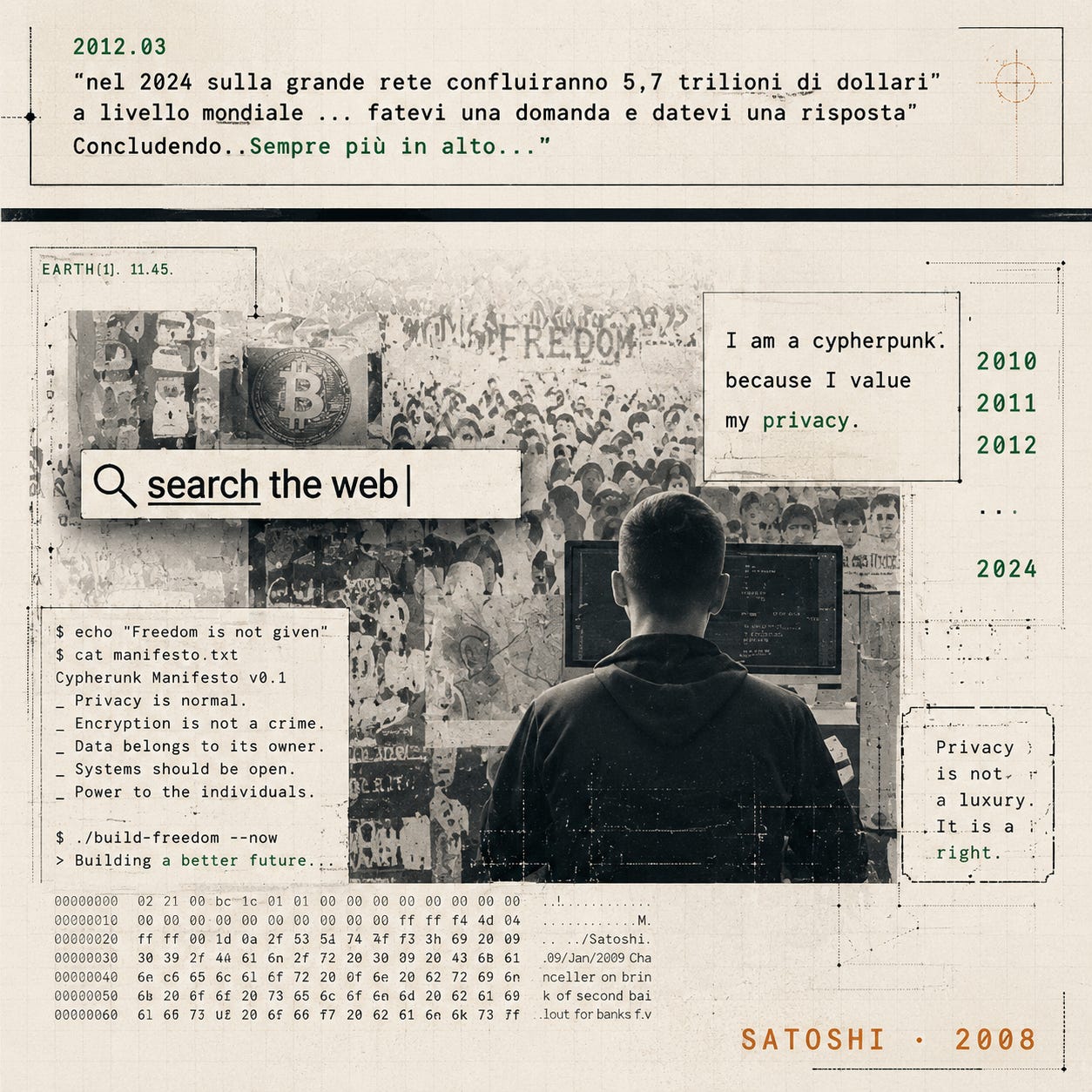
«nel 2024 sulla grande rete confluiranno 5,7 trilioni di dollari a livello mondiale … fatevi una domanda e datevi una risposta»
Concludendo..Sempre più in alto.. →
Dodici anni prima. La cifra e l’anno, scritti. Il 2024 è arrivato dentro quella forchetta.
Niente di tutto questo è profezia, e non rivendichiamo magie. Diciamo una cosa più semplice, e più scomoda: la forma era già leggibile. Il valore si spostava su uno strato senza confini, e il potere — sorveglianza, denaro, geopolitica — seguiva il valore. Bastava guardare.
Cos’è cambiato da allora? Lo strato. Nel 2010 era il web. Ma la forma definitiva del principio non è il marketing, non sono i dati, non è la pubblicità. È il denaro stesso: senza confini, chiunque, ovunque, a costo minimo. Nel 2010 quella frase descriveva il marketing. Oggi descrive Bitcoin.
Dal 2010 al 2024. Stesso principio. Layer diverso. Money.
Archivio completo · dodici post · timestamp pubblici → Federation Archive
La Federation è un collettivo di ricercatori e builder Bitcoin indipendenti. Parlo a suo nome. Non riveliamo i membri — è il lavoro a parlare